
Rooftop solar works well for a lot of properties, but plenty of homes and buildings aren’t set up for it. The roof might face north, or vents and HVAC units might take up most of the usable space. Maybe the building is historic, and you’d rather leave its exterior untouched. Or the roof is in great shape, and your school, dealership, or farm uses more electricity than panels up there could ever produce.
If any of that sounds familiar, a better spot for your panels might be right outside, over the driveway or parking lot.
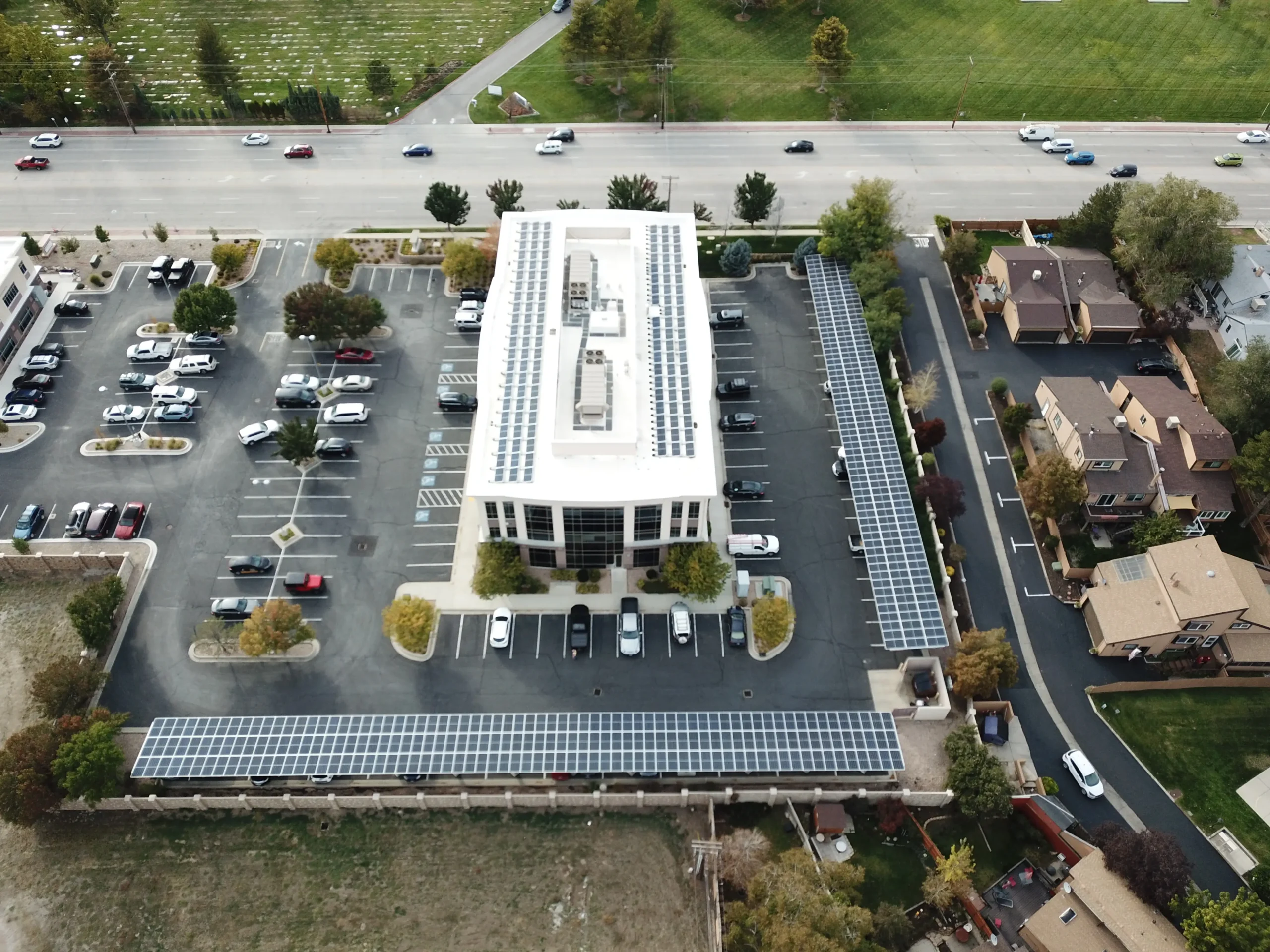
Solar carports and canopies mount panels on a dedicated steel structure above driveways, parking stalls, patios, and walkways. You keep using the space underneath for parking or shade, while the overhead panels generate power for the building next door.
After more than 25 years of designing systems for challenging properties across Utah & Wyoming, our crew at Creative Energies has learned that the best place for solar isn’t always on top of the building.
What Is a Solar Carport?
A solar carport is an elevated steel frame built over one or more parking spaces, with a solar array mounted across the top. Cars park underneath, out of the July sun and the January snow, and the electricity from the panels goes straight to your building. “Solar canopy” is the broader umbrella term covering carports, pergolas, gazebos, and patio covers.
Solar carports and canopies come in a range of sizes. At homes, a solar patio cover adds shade to the backyard, and a one- or two-car carport keeps your vehicles out of the weather. For businesses, schools, and municipalities, a solar carport can stretch across an entire parking lot and cover dozens or even hundreds of spaces.
When a Solar Carport Makes More Sense Than Rooftop Solar
A few situations come up again and again during our site visits:
- The roof is due for replacement. Putting panels on a roof that needs work in a few years means paying to pull them off and reinstall them later..
- Your roof faces north or gets heavy shade. In Utah & Wyoming, the sun travels across the southern part of the sky, so panels on a north-facing roof catch less direct sunlight. A tall spruce shading the roof cuts their output further. Since a carport is built from scratch, we can face the panels south and set the tilt for the most sun.
- Your building is historic, leased, or structurally limited. Preservation rules on a historic building, a lease that doesn’t give you control of the roof, or a roof that’s too weak to support the extra weight can each rule out a rooftop array. With a freestanding carport, none of those issues apply, since nothing gets attached to the building.
- Your electricity use is too high for a rooftop system to cover. A roof only has space for so many panels. For properties that use a lot of power, like cold-storage facilities or manufacturing shops, a rooftop system might cover only a small share of the electric bill. A solar carport gives you room for more panels, so you can build a system large enough to cover more of your energy use.
Why Schools, Municipalities, and Businesses Keep Asking
Schools, city facilities, and commercial properties often have large parking lots that serve one purpose: parking. With a solar carport, that same space can generate electricity while staff, students, and customers continue parking underneath.
The Davis School District took this approach at its bus barn, where we built a 757.6 kW solar carport with 2,196 panels over the district’s fleet. The system offsets 693 tons of carbon dioxide each year, roughly the same as planting more than 15,000 trees. Buses stay cooler in summer, drivers scrape less frost in winter, and the district buys less electricity from the utility.
Organizations with electric fleets can take that a step further. When the buses or trucks parked under a solar carport run on electricity, we can install EV chargers right under the canopy, so the panels overhead help power the vehicles below.
Designed for Rocky Mountain Winters
Heavy snow adds a lot of weight to a carport, so we design each structure for the snow loads and wind speeds in your area. We set the panels at an angle so snow slides off instead of piling up, which means they start generating electricity again sooner after a storm.
Keeping the Power On During Outages
A standard solar system shuts off when the utility’s power goes out, as a safety measure for line workers. If you want electricity during an outage, we can add Tesla Powerwall, Enphase, or Franklin battery storage to your solar carport, which saves extra energy from your panels for later. For businesses and agricultural operations that need equipment running through longer outages, we can also design a solar microgrid, a system that disconnects from the utility grid and runs on its own solar and battery power.
The Trade-Offs
Solar carports cost more than rooftop systems of the same size, since you’re paying for a steel frame and concrete foundations in addition to the panels. In exchange, you get covered parking along with the electricity. Permitting can also take a bit longer, because the structure needs its own engineering review before it’s approved.
Funding can reduce the cost. Rural businesses and agricultural producers may qualify for USDA REAP grants, and Rocky Mountain Power’s Wattsmart program offers incentives for qualifying projects. We help clients track down these opportunities, and you can start on our grants page.
How much you save will depend on your property, how much electricity you use, and how your utility charges for power. We’ll go over estimated costs and savings with you before construction begins, so you know what to expect.
Let’s Find the Best Spot for Your Panels
Rooftop solar works well for many properties, but not all of them. When it isn’t the best fit for yours, a solar carport or canopy gives you another place to install panels and generate your own electricity.
With more than 25 years in business and over 1,200 grid-tied projects completed, our solar craftspeople have designed systems for homes, schools, farms, businesses, and nonprofits. Our NABCEP-certified installers and licensed electricians take care of the structural engineering, permits, and interconnection paperwork with utilities like Rocky Mountain Power. We’re also a Certified B Corporation, a designation that requires us to regularly prove the standards behind our business.
Have a parking lot, driveway, or patio that gets full sun most of the day? Tell us about your property, and we’ll show you how much electricity a solar carport or canopy there could generate.